Frequently Asked Questions
We’ve gathered the most common questions to help you better understand the technologies of the future
Ask a Question
The choice depends on your goals. Autoclave (Prepreg) is the benchmark for aerospace where maximum strength is required. Vacuum Infusion (OOA) is a cost-effective and fast solution for automotive and industrial parts.
Epoxy resin is the best choice for strength. Vinyl ester is ideal for marine environments (chemical resistance), while polyester is the most budget-friendly option for simple tasks.
Carbon is many times stiffer and lighter than steel or aluminum. The specific stiffness of aerospace-grade carbon can be up to 10 times higher than that of metals.
Composite modeling is far more complex than metal modeling. You must account for every layer, its angle, and thickness, using specialized failure criteria like Hashin or Tsai-Wu.
Avoid sharp corners! The minimum radius should be 3-4 mm. This helps avoid defects during lamination and ensures the structural integrity of the part.
CARBOWAVE is a breakthrough using microwave plasma. This reduces energy consumption by 70%, making carbon fiber cheaper and more eco-friendly.
The trend today is functional aerodynamics: diffusers, front splitters, and spoilers that actually improve vehicle handling.
Dry carbon (prepreg) is the choice for professionals; it is significantly lighter and stronger. Wet carbon is better suited for aesthetic tuning due to its affordability.
Yes! By reducing weight and improving aerodynamics, carbon parts can lower air resistance by 20-30%, directly adding kilometers to your range.
It's possible, but requires precision and protection. You'll need materials, epoxy resin, and safety gear. It's best to start with 'skinning' existing parts.
The process involves creating a 3D model, manufacturing a mold, and final lamination using infusion for perfect quality.
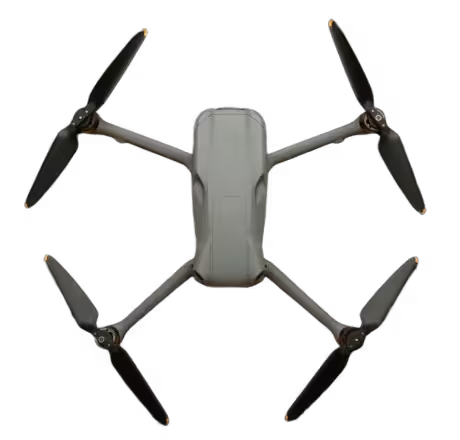
For professional drones, carbon is the undisputed leader. It's lighter, stiffer, and dampens vibrations better, which is critical for sensors and cameras.
Use carbon tubes and sandwich panels instead of solid sheets. This maintains stiffness while significantly reducing structural weight.
They don't deform at high RPMs, provide up to 20% more thrust, and operate significantly quieter than plastic alternatives.
Yes, 3D printing is ideal for creating molds in which the actual carbon fiber parts are then made. This significantly speeds up prototyping.
It allows for the creation of custom prosthetic sockets based on a patient's 3D scan. The process is 60% faster, and the prostheses are much more comfortable.
Carbon returns energy! It works like a spring, absorbing impact and pushing the patient forward, making the gait natural and less tiring.
It's a combination of a carbon chassis with integrated sensors and AI that adjusts prosthetic stiffness to the patient's gait in real-time.
Use the 'tap test': a light tapping with a coin. A dull sound is a sign of internal delamination. Such parts require professional repair.
Yes, through pyrolysis or chemical methods, we can extract fibers from end-of-life parts and reuse them, supporting the environment.
Stay in Touch
Click to see our contact details and location